From a competitive players standpoint: Let’s break down where Amber stands today, where it struggles, and where it shines in this Amber Ink Identity Guide.
If Lorcana’s six inks were a classic RPG party, Amber would be the paladin: noble, supportive, full of good intentions… and occasionally face‑planting because it brought a healing spell to a sword fight. Amber continues to embody the “good” or at least “lawful” side of the color pie.
A quick disclaimer: I will mostly talk about amber in isolation, but there will be sections about dual-ink cards and pairings later. This Guide is currently focused on Core-Cnstructed.
Table of contents
- Amber Ink Identity – lawful good, heroic, and sometimes too nice for Its own good
- General Themes – What Amber wants to do
- Putting the Guide in Amber Ink Identity – Where Amber Stands in the Meta
- Essential Cards by Archetype – Who and What in Amber does it best
- Best Pairings – What combines well with the Amber Ink Identity
- Amber Ink Identity Guide – Final Verdict
Amber Ink Identity – lawful good, heroic, and sometimes too nice for Its own good
Amber is the ink of heroes (even more than other colors) More than half of all Amber characters currently legal in Core are Hero‑sub-type, and the mechanics reflect that moral compass:
- Bodyguard: “I’ll take the hit for you.”
- Support: “I’ll help you hit harder.”
- Singer: “I’ll motivate you.”
- High Willpower: “I’m not dying today,”
It’s wholesome, thematic and also occasionally like trying to win a tournament with a basket of puppies (which sometimes works but I’d recommend playing dogs).
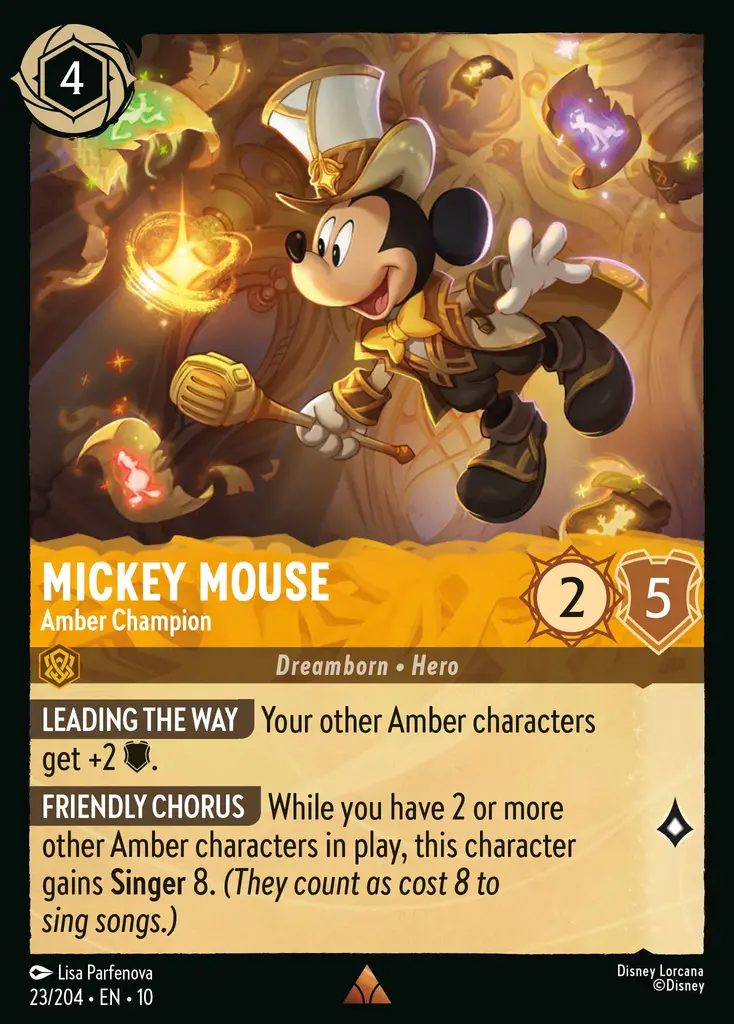
The card that represents all this the best is in my opinion Mickey Mouse – Amber Champion. He supports hes little friends and in return gets supported by them (to sing some tunes with his presumably angelic voice).
General Themes – What Amber wants to do
Amber wants to bring a basket full of puppies and keep it safe and happy. It does this by:
- Singing
- Healing
- Going wide (and rewarding you for it)
- Protection (big bodies shielding your board)
- Recursion (bringing characters back from the discard)
Amber is the color of community, teamwork, and “we’re all in this together.”
Recently Amber also got a “pacifist” theme added to it with Pocahontas cards like Pocahontas – Peacekeeper or John Smith – Snow Tracker which reward you for not changing which might play well into a color locked into aggro anyways.
Putting the Guide in Amber Ink Identity – Where Amber Stands in the Meta
Let’s be blunt: Amber was historically one of the weaker colors but recently got a lot of new tools. Those are mostly leaning into its existing strengths but open up some new venues of play as well. In general is Amber probably the color which gained the most from Winterspell but if that’s enough to push it past the Amethyst dominance remains to be seen.
Strengths
Amber has one real, tangible strength — and when you lean into it, the color can absolutely perform.
- Fast Lore Generation
Amber Ink Identity is closely linked to early and consistent lore pressure. Cheap characters with mane lore pips, which sometimes even are sturdy.
Weaknesses
The weakest parts of amber have been improved but still here they are:
- Card Draw? Only conditional
- Amber’s draw options are mostly:
- As a payoff for Healing like Julieta Madrigal – Excellent Cook and Ohana Means Family
- As a payoff for having a wide board like Stitch – Carefree Surfer and Stitch – Carefree Snowboarder
- As a payoff for playing “Weenies” like Nani – Stage Manager and Stitch – Rock Star
- This used to be one of the weakest parts of Amber but got a lot of new options with Winterspell.
- Amber’s draw options are mostly:
- Interaction? Also conditional
- In general Amber can only remove using conditional cards
- examples are World’s Greates Criminal Mind) and [The Horsman Strikes!
- In general Amber can only remove using conditional cards
- Healing Is Overcosted and Underwhelming
- Healing is one of Amber’s core themes — and yet it’s almost never relevant, expet when enough Cards are attache to it.
The effects are:- too small
- too slow
- too expensive
- Healing is one of Amber’s core themes — and yet it’s almost never relevant, expet when enough Cards are attache to it.
- Singers Are Mostly a Trap
- Amber has a singing theme, but the songs don’t justify the setup:
- Cheap songs like Strength of a Raging Fire give little value when sung early.
- Late‑game songs require so much setup that you might as well just play ramp and skip the choir practice.
- The singers in Ruby have better stats and effects.
- Amber has a singing theme, but the songs don’t justify the setup:
Essential Cards by Archetype – Who and What in Amber does it best
After all this yapping this wouldn’t be a real Amber Ink Identity Guide if we didn’t look at some color defining cards.
Aggro Core
These are your bread‑and‑butter if you want to push early lore and or keep it safe:
- Daisy Duck – Donald’s Date
- Lady – Family Dog
- Tiana – Restaurant Owner
- Grandmother Willow
Fast, efficient, and exactly what Amber needs to get ahead before the opponent starts playing real cards.
Singing Package
If you insist on singing (I won’t judge, I am a steel-song enthusiast after all):
- Angel – Siren Singer
- Mickey Mouse – Amber Champion
- Ursula – Vanessa
These are the only singers that feel worth the deck slots.
Recursion Tools
Amber’s recursion is surprisingly solid when it comes to characters. It could be summarized in the other two archetypes but i wanted to point it out:
- Lilo – Escape Artist
- Circle of Life
If you want to loop value, this is your best angle. Lilo of course goes into the aggro style deck while Circle of Life belongs to the singers.
Healing Package
Before Winterspell the answer was none. Now one card makes this Category by the sheer potential if its drawing power:
- Ohana Means Family
Best Pairings – What combines well with the Amber Ink Identity
Amber shines brightest when paired with a color that covers its weaknesses (and supports the aggro playstyle). WIth some new additions (especially Raging Storm) there might be a Control Deck hidden somewhere but i think aggro is where Amber is still at.
- Steel: fixes interaction, gives removal, card draw and more aggro
- Emerald: adds disruption, card filtering and more aggro
The issue of dual ink cards and the Amber Ink Identity
No other color has their high impact cards so far spread out between all their dual ink pairings like amber. While for example Amethyst decks use 0-2 play-sets of dual ink cards (like Into the Unknownor Giant Cobra – Ghostly Serpent). Many problems of amber would be fixed if some of those dual cards would just be amber cards.
The Amber/Steel dual cards for example all feel like amber cards with resist tagged on and should have probably just been regular amber cards. You you will likely find Rhino – Power Hamster, Penny – Bolt’s Person andThe Troubadour – Musical Narrator in most Amber/Steel decks.
In Amber/Emerald you play almost all dual cards. Some cards like Tramp – Street-Smart Dog feel like they should be dual color for their effect per character and discard, but cards like Lady – Decisive Dog and Lady – Miss Park Avenue should in my opinion just be Amber since its classic going wide payoff and/or character recursion.
Amber Ink Identity Guide – Final Verdict
Amber got quite a Buff which patched many of its major weaknesses. It’s the best standalone color for Aggro strategies and if those are able to compete the color will shine. Winterspell helped Aggro out a lot but also brought a lot of Control tools so it’s still quite open how well Amber can perform.
Amber in Core Constructed is a color with a strong identity, great flavor, and now more than a few standout cards — but it might be held back by to strong of a Control/Mid range Meta.
Still, with the right partner and the right build, Amber can shine — I’d just stuck to Aggro for now.
I hope you liked reading this Amber Ink Identity Guide. Feel free to hit me up on my socials if I missed anything or you want to further discuss.

Leave a Reply