Category: Guides

  • Best Franchise Theme Decks

    Best Franchise Theme Decks

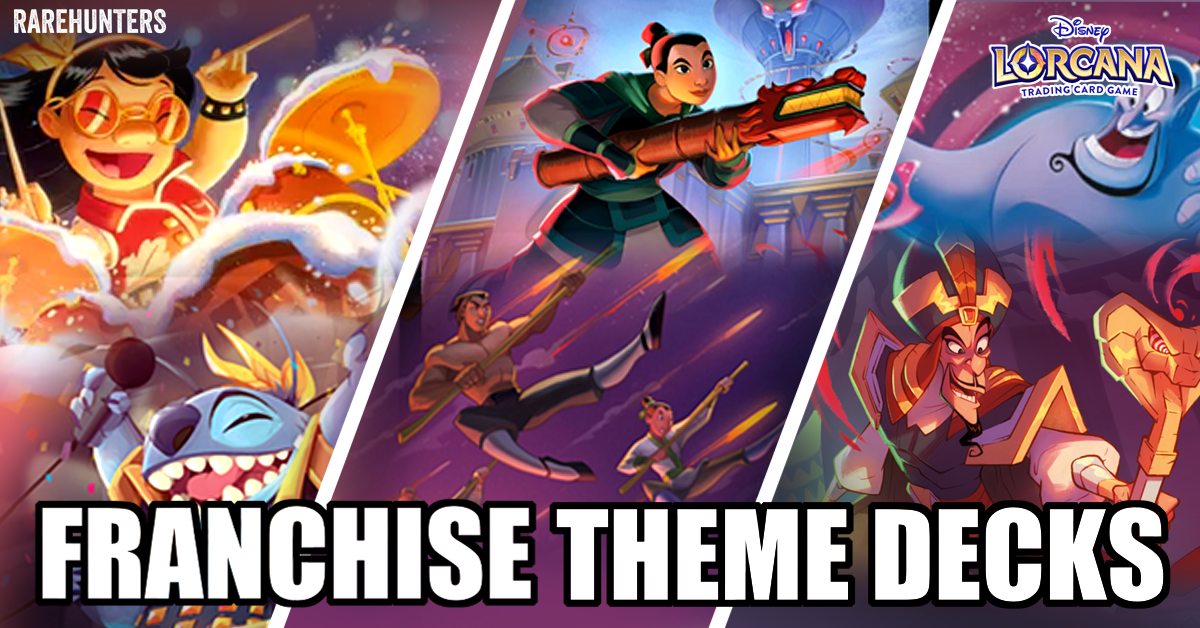
    franchise theme decks pic

    At Rarehunters, we’re usually in it to win it—sleeving up the sweatiest lists for Core and Infinity events. But every now and then, it’s healthy to take a step back and ask the real question: How can I apply that same sweaty mentality to casual events? With Rarehuntershop hosting its quarterly Franchise / Movie Theme Deck Event, this feels like the perfect moment to share my top picks for this unique and surprisingly competitive environment.

    Deck Building Rules

    There’s no official Franchise Format in Lorcana, but Rarehuntershop uses the following rules for its events:

    • Minimum of 60 cards
    • Maximum of 2 ink colors
    • All sets are legal
    • Only cards from one franchise may be used
      • e.g., only cards from Hercules
    • Additionally, “Disney Lorcana” cards may be included
    • These are cards that exist only in Lorcana lore
    • Examples: Emerald Chromicon, Winterspell

    In short: It is Infinity Constructed with one extra restriction

    Fun Edge Cases to Discuss With Your TO

    The rules seem simple, but Franchise Format opens the door to some hilarious grey areas. I still don’t have definitive answers to these, but maybe your TO does:

    • Which franchise do Mickey, Donald, and friends belong to?
    • Is Mickey – Wayward Sorcerer part of the general Mickey franchise or Fantasia?
    • Are Duck Tales separate from the Mickey franchise?
    • If I play a Wreck-It Ralph deck, can I run all the Disney Princesses because they cameo in the second movie?
    • There was an Aladdin / Hercules crossover once—does that make them one franchise now?

    To keep this guide clean, I’ll stick to clear-cut cases only.

    What Makes a Good Franchise Theme Deck?

    Since you’re locked into a single franchise, your card pool is tiny. Therefore true control strategies are nearly impossible. You simply don’t have the tools. That leaves two archetypes:

    • Aggro
    • Midrange

    All three of my top picks lean toward midrange, but I’ll share some aggro notes later.

    A strong midrange deck needs three things:

    • Efficient characters (good stats for cost)
    • Card draw
    • Interaction

    The good news? All three of my featured decks check those boxes.

    Honorable Mentions (More Good Franchise Decks)

    Before we get to the top 3, here are some strong franchises that almost made the cut but have notable drawbacks.

    Beauty and the Beast

    Best Ink Combination: Amethyst / Steel

    Advantages

    • Excellent card draw: The Library – Gift for Belle, Beast – Tragic Hero
    • Solid interaction: Belle – Accomplished Mystic, Grab Your Sword

    Disadvantages

    • Weak early game
    • Slow to reach 20 lore

    Snow White and the Seven Dwarfs

    Best Ink Combination: Amber / Steel

    Advantages

    • Fast, aggressive game plan
    • Extremely resilient closers: The Prince – Never Gives Up, Snow White – Fairest in the Land

    Disadvantages

    • Relies heavily on Doc – Bold Knight for card draw
    • Limited interaction outside Seven Dwarfs’ Mine – Secure Fortress

    Pocahontas

    Best Ink Combination: Amber / Amethyst

    Advantages

    • The fastest franchise deck available
    • Very easy to pilot—just turn your characters sideways

    Disadvantages

    • Zero interaction
    • If you fall behind, you’re done

    Top 3 Franchise Theme Decks

    Lilo & Stitch – The New Kid (and Alien) on the Block

    Amber / Steel has recently resurfaced in Core Constructed, and it shines just as brightly in the Franchise Format. This deck floods the board with adorable aliens (and fish) and rewards you for doing so. It is one of the fastest in the franchise theme deck format.

    Efficient Characters

    • Two-thirds of your deck quests for two or has a fantastic text box
    • Your curve is smooth and relentless

    Card Draw

    This deck’s card draw is absurd:

    • Stitch – Carefree Snowboarder (“Austrian Stitch”) and Stitch – Rockstar as payoffs
    • Nani – Stage Manager to find more Stitch pieces
    • Lilo – Escape Artist and Lilo – Rock Star for recursion and value loops

    Interaction

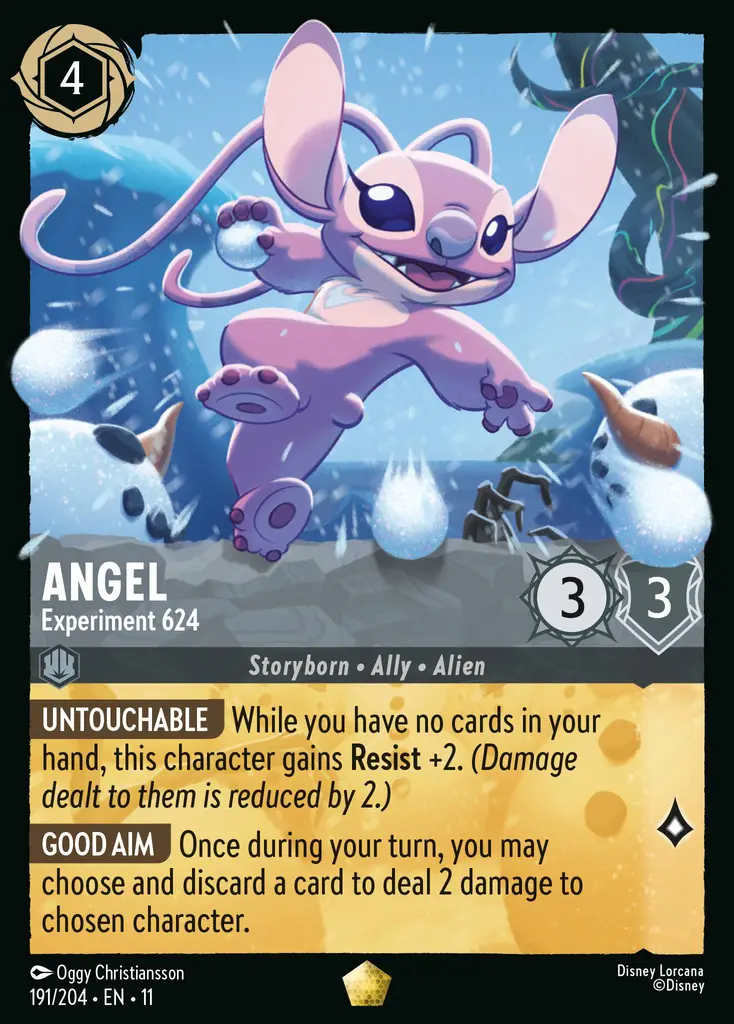
    • Angel – Experiment 624 is often all you need
    • Lilo – Best Explorer Ever stabilizes against aggro
      • Add <strong>Gigi – Best in Snow</strong> if evasive characters worry you

    Mulan – Ruby / Steel Has to Be Good Somewhere

    Ruby / Steel is a dream many Lorcana players chase in competitive formats. Franchise Deck Format finally makes it real. You get eight removal actions, premium challengers, and lore generation all in one package.

    Efficient Characters

    • Turns 1–2 are a bit slow, but everything afterward is a threat
    • Mulan – Ready for Battle is a standout, especially with ways to cheat her out early

    Card Draw

    Historically Ruby / Steel’s weakness, but Mulan fixes that:

    • Marching Off to Battle
    • Medallion Weights

    Interaction

    • Strength of a Raging Fire and Light the Fuse to clear boards
    • Mulan – Charging Ahead, Li Shang – Newly Promoted, and Mulan – Imperial General to combat stale boards
    • Add Imperial Bow if evasive decks are common

    Aladdin – Illusions and Card Draw

    If Core Constructed taught me anything post-rotation, it’s this:
    Card draw is king, and Illusion characters are busted when actions are scarce.
    Aladdin (or more accurately, Jafar and Genie) brings both to the Franchise Deck Format.

    Efficient Characters

    • Illusion characters have stats far above rate
    • Many characters come stapled to card draw with no tempo loss

    Card Draw

    Half your deck draws cards, but the highlights are:

    • Genie – Supportive Friend
    • Genie – Wish Fulfilled

    Interaction

    • The Lamp draws two cards and bounces a threat—absurd value
    • Jafar – Aspiring Ruler and Hypnotic Strength offer combat tricks
    • Jafar – Tyrannical Hypnotist buys time against Mulan and other midrange decks

    Franchise Theme Decks – Conclusion

    Franchise Theme Deck events may look casual on the surface, but the format rewards tight deckbuilding and smart gameplay just as much as any competitive event. With limited card pools and quirky restrictions, the challenge becomes finding the franchises that naturally offer efficiency, card draw, and interaction—the holy trinity of midrange success.

    Lilo & Stitch overwhelms with value, Mulan brings discipline and removal, and Aladdin leverages illusions and card advantage to outpace almost anything. Whether you’re here to win or just to flex your favorite movie, these decks give you the best of both worlds.

    Sleeve up your favorite franchise and enjoy the flavour!

    Best Franchise Theme Decks Author Photo

    Tell me about all the cool franchise decks I missed on my socials.

    If you want to read more – here are more guides and articles. If you are new to Lorcana or a returning player I can recommend our Ink Identity series:
  • Steel Ink Identity Guide

    Steel Ink Identity Guide

    Steel Ink Identity Guide Photo

    To complete our fantasy party: Steel is best represented by the fighter/warrior. Fast and hard hit and when he seems out of gas he gets his second wind. Direct Damage, fast Lore and Card Draw when your hand is empty is the way of Steel. Let’s look at the warriors strengths in this Steel Ink Identity Guide.

    Steel has been an interesting color since Lorcans inception. It’s got answers for every card type in the game, but maybe not always the most “refined”.
    Like all other guides, this article focuses almost entirely on Steel itself. Dual‑ink combinations or specific decklists are a side topic. You’ll find more about those in our deck‑specific guides.
    This steel ink identity guide sharpens that focus even further.

    Steel Ink Identity — The Warrior’s Creed

    A steel warrior in Lorcana has to decide if he is an aggressive fighter or a noble knight. The stats and Keywords resemble that duality.

    Each keyword feels like a battlefield oath:

    • Evasive on your Turn / Alert: “Nothing escapes my watch”
    • Challenger: “I’ll avenge my comrades”
    • Bodyguard: “Shieldwall! Hold the line!”
    • Resist: “My armor is impenetrable”
    • Balanced Stats: “I’m equipped for the situation”
      • With a tendency of higher strength on low cost characters
      • and high defense on high cost characters

    This dual nature — brawler vs. knight — is at the heart of every steel ink identity interpretation.

    I think the card that represents Steel the most is the new Angel – Experiment 626. She Comes down, immediately lets you use one of your less needed cards and starts wrecking lesser foes.

    Steel Ink Identity most representing card: Angel Experiment 624

    General Themes — What Steel Wants to Do

    The Steel Ink identity is polished as a blade and the trained expert who wields it: Efficient and fast movements and not giving up even if the odds are against you.

    Here’s what Steel excels at:

    • fast Early lore
    • efficient early board Control
    • finding the right weapon (card) for the situation with card filtering
    • refilling your hand when your options are exhausted

    Steel is at its best in the early and mid game but falls off the longer the game progresses. But it also has the tools to have some endgame reach if you weren’t able to establish dominance that fast.

    Steel also has some big boys and girls (like Tinkerbelle – Giant Fairy) if you want to make a splash but I’d stick to the fast and dirty route with this color.

    This section is the beating heart of any steel ink identity guide, showing how the color fights and survives

    Steel Ink Identity Guide: Where it Stands in the Meta

    Because of its early game power and refilling capabilities the Steel Ink Identity has a place in all styles of decks except the controliest of control decks. Let’s examine that a little closer.

    Strengths

    • Strong early Questers
      • Steel is lacking a quest for two one drop. Other than that you can’t wish for more. Nala – Undaunted Lioness and Lilo – Bundled Up are the most aggressive 2 drops in the game.
    • Strong early Board Control
      • Additionally to strong questers steel also boast the beast early control characters with cards like Calhoun – Marine Sergeant and Captain Hook – Forceful Duelist.
    • Strong early/midgame Interaction
      • Before rotation a whole archetype of deck was a menace because of this particular strength of Steel.
      • Cards like Strength of a Raging Fire and He Hurled His Thunderbolt are regular checks in the meta if characters are “playable” (Dies to Thunderbolt may be a also a joke but it is a valid consideration if a character is worthwhile playing)

    Weaknesses

    • Endgame on the weaker side
      • Steel has strong Endgame Characters like Vincenzo Santorini – The Explosives Expert and Ariel – Sonic Warrior which are no doubt powerful but fall short when compared to other colors finishers like Hades – Infernal Schemer or Maui – Half-Shark.
    • The best card draw works only if your hand is empty
      • Steel has some very strong card draw options like Doc – Bold Knight but I put it as a weakness since you can’t hoard cards like Amethyst.
      • You have to commit your resources to the board and then refill or not draw at all

    Essential Cards by Archetype — Who Are the Best of the Best in the Steel Ink Identity?

    So we Steel warrior hit and hard and fast, but who is the fittest among our ranks?

    Card Draw (if your hand is empty)

    • Doc – Bold Knight
    • Desperate Plan
    • Goliath – Clan Leader

    Card Selection / alternative use of unneeded cards

    • Mulan – Disguised Soldier
    • Namaari – Single-Minded Rival
    • Angel – Experiment 626

    Early Questers

    • Nala – Undaunted Lioness
    • Lilo – Bundled Up
    • Lawrence – Jealous Manservant

    Early Control

    • Captain Hook – Forceful Duelist
    • Calhoun – Marine Sergeant
    • Black Heron – Real Bad Egg
    • Lexington – Small in Stature

    Interaction

    • Fire The Cannons
    • Strength of a Raging Fire
    • He Hurled His Thunderbolt

    Best Pairings — What Combines Well with the Steel Ink Identity

    The Steel Ink Identity, quite similar to Amethyst, revovles around being versatile. You can combine it with every other color and get a deck which is at least somewhat good.

    The best combinations of course are those which lean into the strengths of steel and focus on the early or midgame. Those two colors are currently Amber and Amethyst.

    But don’t feel discouraged to try other combinations. If the Steel Ink is in the mix it can work in your favor.

    Amber — The Squire at the Warrior’s Side

    • Even more early questing power with cards like Daisy – Donald’s Date
    • Even faster gameplans with cards like Lady – Family Dog and Grandmother Willow – Ancient Advisor
    • Singers for your removal Songs like Angel – Siren Singer and Ursula – Vanessa

    Amethyst — The Battlemage Ally

    • More access to card draw with cards like Genie – Wish Fulfilled and Yzma – Conniving Chemist
    • both of these also double as midrange questers
    • Also access to a surprisingly fast aggro package with Pocahontas – Following the Wind, Christopher Robin – Joining the Fun and Genie – Magical Researcher
    • Breaking stale boardstates with Elsa – Spirit of Winter and Demona – Scourge of the Wyvern Clan

    Steel Ink Identity Guide — Final Verdict

    The Steel Ink Identity enables everything that wants to go fast (or at least not slow). Like Amethyst it has a steady place and the Meta since Lorcanas inception and this will also be the case in Winterspell. If you like straightforward Gameplans Steel is the color for you.

    I hope you enjoyed this Amethyst Ink Identity Guide. If you think I missed something or want to dive deeper, feel free to reach out on my socials.

    Steel Ink Identity Author Photo
  • Sapphire Ink Identity Guide

    Sapphire Ink Identity Guide

    Sapphire is the Wizard of the group. The ink of scholars, planners, and meticulous spell‑slingers. Where Amethyst reacts with instinctive sorcery, Sapphire prepares, calculates, and executes with precision. It rewards players who enjoy assembling engines, sequencing perfectly, and watching a plan unfold exactly as intended. I hope i can show you the joy of planning in this Sapphire Ink Identity Guide.

    As with the other Ink Identity Guides, this article focuses on Sapphire as a standalone color, not on dual‑ink synergies or specific decklists. For deeper dives, check out the deck‑specific guides.

    Sapphire Ink Identity – The Wizard’s Tome

    Wizards, much like Rogues, carry an entire workshop of tools — but theirs are arcane, refined, and carefully catalogued. Sapphire characters reflect this overlap through their keywords:

    • Evasive (On your turn)“I will reveal the unseen.”
    • Ward“Your meager spells can’t hurt me.”
    • Resist“Neither can your weapons.”
    • Support“With me, you’ll achieve greatness.”
    • High Defensive Stats“I’ll live and learn from this encounter.”

    Persistence and preparation define Sapphire.

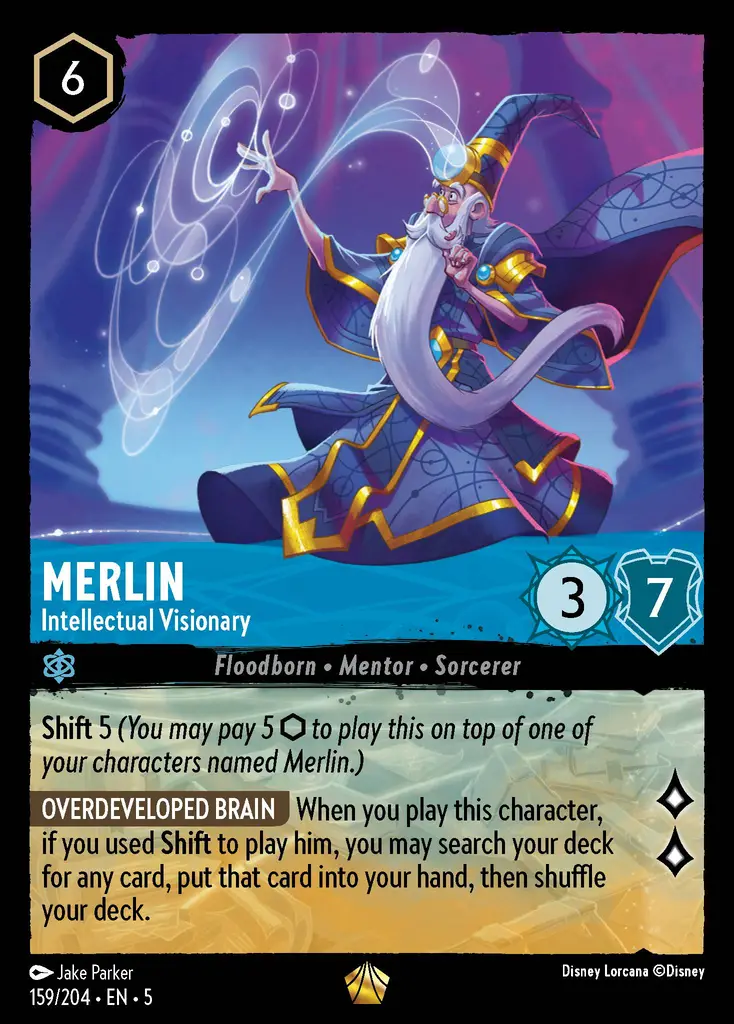
    The ink’s core identity is finding the right spell at the right moment, and no card embodies this better than Merlin – Intellectual Visionary. Even if he never dominated the meta, his ability to shift and fetch exactly what you need is the purest expression of Sapphire’s philosophy: knowledge is power, and preparation is victory.

    General Themes – What Sapphire Wants to Do

    Right now, successful Sapphire decks revolve around setup. They don’t win by brute force or tempo spikes. They win by assembling the perfect sequence.

    Here’s how Sapphire approaches the game:

    • Ramp
    • Find Combo Pieces
    • Extract Value from Combo Engines
    • Control the opponent until your payoffs arrive

    Sapphire does have an aggro subtheme and an item‑centric subtheme, but neither is relevant in the current meta. They’re like spells in the back of the wizard’s spellbook — waiting for the right moment to shine.

    Sapphire Ink Identity Guide: Where Sapphire Stands in the Meta

    Sapphire is well‑positioned in the current metagame. It supports both control strategies and top‑heavy midrange decks, thanks to its near‑monopoly on consistent ink ramp. If you want to play big, expensive, game‑ending cards, Sapphire is the ink that lets you get there.

    Strengths

    • Most consistent ramp in the game
      • Sapphire has ramp options at nearly every point on the curve — 2, 3, 4, and 5 ink.
      • Examples:
        • Tipo – Growing Son
        • Cinderella – Dream Come True
    • Strong control tools
      • Best spot removal in the game: Hades – Infernal Schemer
      • Excellent anti‑aggro tech: Spooky Sight
    • Best card selection in Lorcana
      • Sapphire doesn’t draw many cards, but it finds the right ones more reliably than any other color.
      • Example:
        • Vision of the Future

    Weaknesses

    • Lack of direct card draw
      • Sapphire has no meaningful raw draw.
      • Its “draw” is tied to ramp replacement effects like:
        • Sail the Azurite Sea
        • Cinderella – Dream Come True
        • Moana – Curious Explorer
      • Recently it also got a solid card draw “engine” with Pete – Ghost of Christmas Future
    • Weak early and midgame
      • Compared to other colors, Sapphire lacks:
        • strong early control
        • impactful early questers
      • This is mitigated by ramp, but you’ll often start behind on board and lore before stabilizing.

    Essential Cards by Archetype – The Wizard’s Favorite Spells

    The best cards in the Sapphire Ink Identity are those that set up future turns or help you recover the board after spending early turns preparing your engines.

    Ramp

    • Tipo – Growing Son
    • Sail the Azurite Sea
    • Pleakly – Scientific Expert
    • Cinderella – Dream Come True
    • Kida – Creative Thinker

    Card Selection

    • Develop Your Brain
    • Vision of the Future

    Control

    • Hades – Infernal Schemer
    • Spooky Sight
    • Sudden Scare
    • Let It Go

    Best Pairings

    The Sapphire Ink Identity currently has two highly successful pairings. Amethyst and Emerald. And one pairing on the brink of greatness: Steel. (Sapphire/Steel cultists, I see you. I want the comeback too.)

    Amethyst

    This pairing turns you into the greediest midrange deck in Lorcana. Together, Sapphire/Amethyst becomes a value‑driven, inevitability‑focused powerhouse.

    Amethyst provides:

    • Card draw via
      • Genie – Wish Fulfilled
      • Dumbo – Ninth Wonder of the Universe
      • Demona – Scourge of the Wyvern Clan
    • Midgame stabilization through
      • Tigger – Bouncing All the Way
      • Elsa – The Fifth Spirit
      • Cheshire Cat – Inexplicable
      • Belle – Accomplished Mystic

    Emerald

    This pairing transforms you into the controlliest control deck in the game. If you enjoy dismantling your opponent’s plans piece by piece, this is your ink duo.

    Emerald adds:

    • More tempo and control tools like
      • Prince Phillip – Vanquisher of Foes,
      • Under the Sea
    • Hand manipulation and subgames via
      • Clarabelle – Light on Her Hooves,
      • Basil – Undercover Detective,
      • Bend to My Will

    Steel

    This pairing feels like a wizard forging enchanted armor and summoning titanic constructs.

    Steel gives Sapphire the ability to:

    • Play the biggest characters in Lorcana
    • Become the Steel Song deck in Core
    • Or do both at once

    Steel adds:

    • The best removal songs:
      • Strength of a Raging Fire,
      • He Hurled His Thunderbolt
    • Massive stat sticks like
      • Vincenzo Santorini – The Explosives Expert
      • Ariel – Sonic Warrior
    • Emergency card draw when your hand is empty via
      • Doc – Bold Knight,
      • Goliath – Clan Leader,
      • Beyond the Horizon

    Sapphire Ink Identity Guide – Final Verdict

    Sapphire is in an excellent spot if you enjoy top‑heavy decks, control strategies, or carefully assembled engines. Its ramp and card selection make it one of the most reliable inks in the game.

    Two subthemes — items and princess/puppy aggro — currently sit on the sidelines, but with a bit of support they could open entirely new playstyles.

    A theme which might become relevant is “Boost”. Time will tell but I’m excited to try it.

    For now, Sapphire remains the ink of wizards, planners, and players who love winning through preparation and precision.

    I hope you enjoyed this Sapphire Ink Identity Guide. If I missed anything or you want to discuss further, feel free to reach out on my socials.

    Sapphire Ink Identity Author Photo

  • Ruby Ink Identity Guide

    Ruby Ink Identity Guide

    Ruby is the Barbarian of the group. It hits hard, smashes through weaker characters without hesitation, and brings raw, unfiltered strength to the table. While these qualities are impressive (and very much my vibe), they’re not exactly ideal in a meta where half the board is evasive and refuses to stand still long enough to get punched. I’ll show you why in this Ruby Ink Identity Guide.

    As with the other Ink Identity Guides, this article focuses almost entirely on Ruby as a color, not on dual‑ink synergies or specific decklists. If you want deeper dives into pairings, check out our deck‑specific guides.

    Ruby Ink Identity – The Barbarian’s Battle Cry

    The Barbarian isn’t a mindless brute. Ruby has tools to reach evasive opponents, and lately it has learned to shout loud enough to shake the battlefield thanks to its growing suite of songs and singers. Ruby characters typically bring:

    • Evasive“Can’t hide from me.”
    • Rush“Faster to the challenge.”
    • Singer“Let my warcry echo.”
    • High Attack Stats (and strong stats overall)“You’re not walking away from this.”

    Everything in Ruby is built to challenge aggressively. And if there’s nothing left to challenge? Well, then we boast (sing) about our victories until someone shows up to get hit.

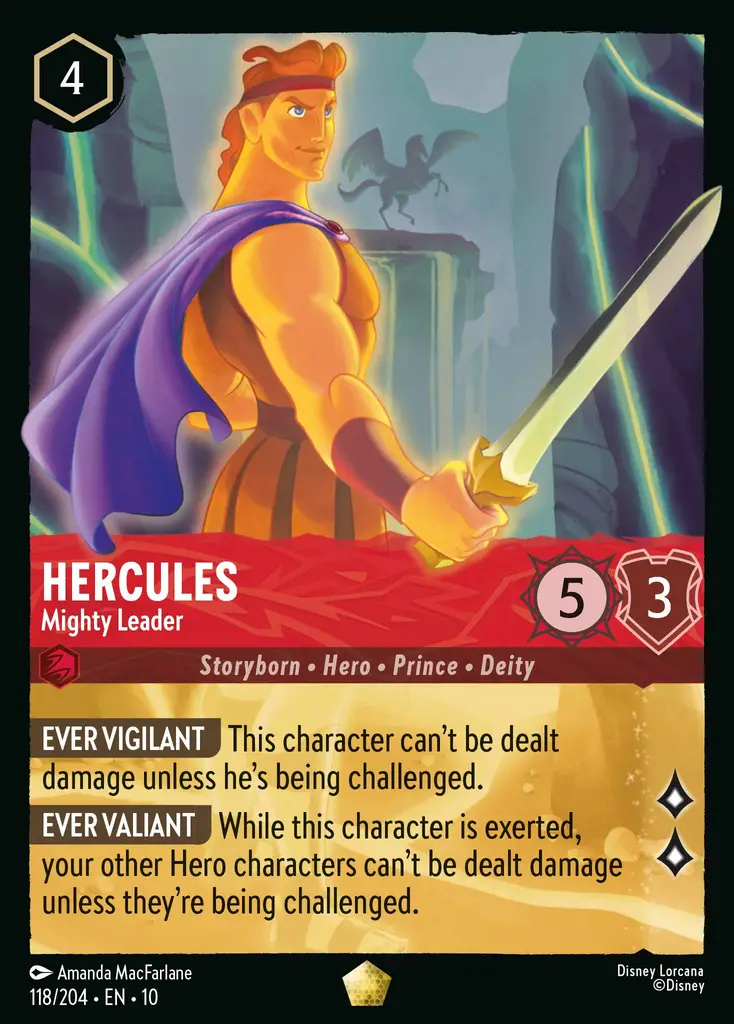
    In my opinion, the definitive Ruby card is Hercules – Mighty Leader. He’s aggressively statted, shrugs off damage while challenging, and inspires your entire board to do the same. A true Barbarian captain.

    Ruby Ink Identity Pre‑Rotation

    Ruby changed more than any other color after rotation (Set 9). Early sets leaned heavily on efficient evasive characters with low attack but high lore pips — think Minnie Mouse – Stylish Surfer — and even included a full board reset in Be Prepared, a card that never really matched Ruby’s core identity but was undeniably powerful.

    With rotation, Ruby lost some of those tools and is still rediscovering what it wants to be.

    General Themes – What Ruby Wants to Do

    Ruby Ink Identity is all about fighting for the board. Or, honestly, fight in general. Here’s how it approaches the game:

    • Challenge (to control the board)
    • CHALLENGE (to gain lore)
    • C H A L L E N G E (to draw cards)
    • Make Strength matter (beyond just challenging)
    • Use spot removal (for things it can’t punch directly)

    The color that looks at every problem and asks, “Can I hit it?” is definitely Ruby.
    And if the answer is no, it finds a way to make the answer yes.

    Ruby Ink Identity Guide: Where Ruby Stands in the Meta

    Ruby is in a strange place right now. It recently received a wave of strong cards and has excellent characters across all stages of the game. But without consistent targets to challenge, Ruby runs out of gas fast.

    Right now, it’s tied with Amber as one of the weaker colors. But that could change instantly with just a bit more support against evasive or stalled boards.

    Strengths

    • Strong Early Game Characters
      • Other colors must choose between early lore or early control. Ruby gets both.
        • Example: Diablo – Watchful Raven
    • Strong Midgame Characters
      • Ruby excels at “removal on a stick.”
        •  Example: Headless Horseman – Terror of Sleepy Hollow
      • Ruby has excellence stated mid game characters with upside
        • Example Goliath – Guardian of Castle Wyvern
    • Strong Late Game Characters
      • Even bigger removal on a stick.
        • Example: Maleficent – Monstrous Dragon
      • High-Impact Finishers
        • Example: Maui – Half‑Shark

    Weaknesses

    • No challenges = no card draw
      • Ruby’s draw engines all require challenging:
        • Queen of Hearts – Sensing Weakness
        • Medallion Weights
        • David Xanatos – Charismatic Leader
      • Recently some Card Draw has been added but its conditional and/or maybe to expensive
        • Marching off to Battle
        • Kristoff’s Lute
    • No way to accelerate into mid/late game
      • At least not in Core
    • Power locked behind un‑inkable cards
      • Ruby has more un‑inkables than most colors.
        • Check any Ruby/Amethyst list — guess which color brings the bulk of them.
      • This forces harder deckbuilding decisions and often means running 2–3 copies of cards you’d prefer to play at 4.

    Essential Cards by Archetype – Who Rises to the Challenge

    The Ruby Ink Identity shines brightest when it’s fighting. These are the cards that enable that plan.

    Early Control & Aggro

    • Tinker Bell – Fancy Footwork
    • Diablo – Watchful Raven
    • Sisu – Emboldened Warrior

    Removal on a Stick (Characters)

    • Sisu – Daring Visitor
    • Headless Horseman – Terror of Sleepy Hollow
    • Maleficent – Monstrous Dragon

    Challenge Experts

    • Maui – Half‑Shark
    • Queen of Hearts – Sensing Weakness
    • David Xanatos – Charismatic Leader
    • Hercules – Mighty Leader

    Challenge Support

    • Lumiere – Fiery Friend
    • Next Stop, Olympus

    Best Pairings

    Right now only Amethyst seems like it has the tools to help out Ruby. There is some hope Amber or Sapphire can fill that Role as well and if that hope turns out to be true I’ll add those colors to this list.

    Amethyst

    Historically and currently, Ruby/Amethyst is the powerhouse pairing. Amethyst provides:

    • Card draw without needing to challenge
      (e.g., Genie – Wish Fulfilled, Dumbo – Ninth Wonder of the Universe)
    • Exerting opposing characters so Ruby can smash them
      (e.g., Elsa – The Fifth Spirit)
    • More evasive characters to help deal with sneaky threats
    • Healing AND more damage via Belle – Accomplished Mystic or Cheshire Cat – Inexplicable

    Other pairings (Amber, Sapphire and Steel)have shown moderate success, which suggests Ruby is close to reclaiming its former strength.

    Ruby Ink Identity Guide- Final Verdict

    Ruby the Barbarian is powerful, flavorful, and has one meta‑relevant deck with several others on the verge of greatness. With just a few more tools (maybe another magical sword or two), Ruby could easily return to its former glory.

    I hope you enjoyed this Ruby Ink Identity Guide. If I missed anything or you want to discuss further, feel free to reach out on my socials.

    Ruby Ink Identity Author Photo
  • Emerald Ink Identity Guide

    Emerald Ink Identity Guide

    Emerald Ink Identity Guide Photo

    We’ve already met the noble Paladin in Amber and the scheming Wizard in Amethyst. Now it’s time to slip into the shadows and talk about the morally gray operative of the group: Emerald, the classic Rogue. Let’s have a look at it’s tools in this Emerald Ink Identity Guide.

    Emerald disrupts, steals tempo, punishes over extension, and thrives when the opponent gets too comfortable. If Amethyst defines the meta, Emerald is the color that says:

    “Fine. I’ll just rob the meta instead.”

    If you refuse to play Amethyst but still want to win, Emerald is your best weapon.

    This guide focuses on Emerald as a standalone identity. For deeper deck‑specific breakdowns, check out our guides.

    Emerald Ink Identity – The Rogue’s Toolkit

    A Rogue never enters a dungeon without a toolbelt — and Emerald embodies that perfectly.
    It is arguably the most flexible color in Lorcana, with cards that often have multiple modes or conditional ceilings. Emerald can “do everything,” but always with a twist:

    • sometimes the effect is gated behind specific conditions
    • sometimes the efficiency is slightly worse than other colors
    • sometimes the payoff is enormous… if you set the trap correctly

    Emerald’s keywords reflect this slippery, evasive, opportunistic nature:

    • Evasive“They’ll never catch me.”
    • Ward“They can’t touch me.”

    Mixed Stats“I’m a specialist,  not a generalist.”

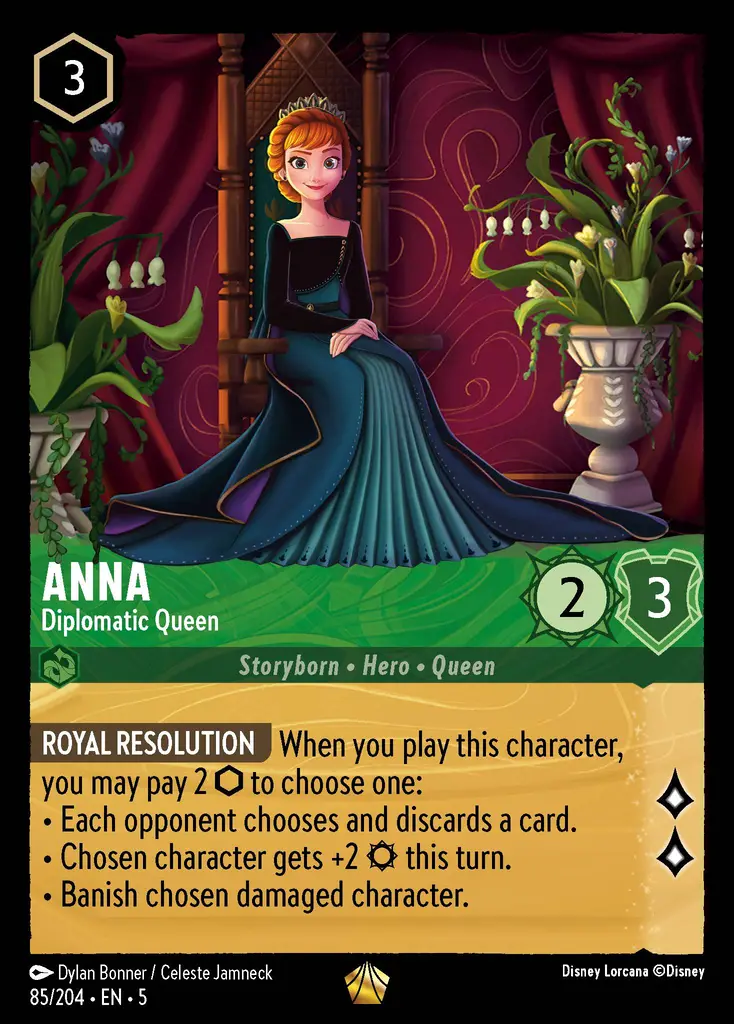
    The card that captures Emerald’s identity best is Anna – Diplomatic Queen:
    a modest 3‑drop or a highly flexible 5‑drop depending on how you play her.
    That duality is Emerald.

    General Themes – What Emerald Wants to Do

    Emerald currently plays two very different game-plans and they rarely overlap.

    End the Game Quickly (Aggro Rogue)

    Emerald’s aggressive plan aims to snowball early and force the opponent into awkward lines:

    • Deploy strong early questers
    • Strip removal from the opponent’s hand
    • Make interaction difficult or inefficient
    • Punish opponents for interacting with your board

    This is the Rogue darting through the battlefield, picking pockets, and vanishing before the enemy can react.

    Set a Trap and Control the Late Game (Control Rogue)

    The other side of Emerald is the patient assassin:

    • Catch up on resources
    • Wipe the board
    • Bounce opposing characters
    • Force discards to empty the opponent’s hand

    This is the Rogue who waits in the rafters until the perfect moment to strike.

    A Note on “Damage Matters” and Boost in the Emerald Ink Identity

    Emerald has a small damage‑synergy package with cards like Scar – Vengeful Lion and his hyenas.
    Right now, outside of Prince Phillip – Vanquisher of Foes, it’s not impactful enough to define the color

    The same can be said about a now bigger Package concerning itself with Lorcana’s newest Mechanic “Boost”. Some strong support cards have been added like Donald Duck – Fred Honeywell and Minnie Mouse – Mrs. Cratchit

    Both of these themes are interesting but havent manifested themself in the meta as of now – so we’ll leave them aside for now.

    Emerald Ink Identity Guide: Where Emerald Stands in the Meta

    Emerald thrives when opponents try to build large ink pools or big hands.
    Since most meta decks run Amethyst, Sapphire, or both, Emerald often finds itself in a favorable position.

    Strengths

    • Aggressive Early Game Options
      • Emerald has some of the best early questers in the game (second only to Amber), often paired with disruption.
      • Examples: Banzai – Gluttonous Predator, Cursed Merfolk – Ursula’s Handiwork
    • Strong Late Game Control Tools
      • Emerald stabilizes extremely well once it reaches its power cards.
      • Example: Basil – Undercover Detective
    • Strong Mid Game Disruption Tools
      • Examples: Emerald Chromikon, Snow Fort
    • Boardwipes
      • Lorcana’s core format has 4 boardwipes in total. Emerald brings two of them.
      • Prince Phillip – Vanquisher of Foes, Under the Sea

    Waeknesses

    • Weak Early Game Control
      • Mostly challenge‑based removal
      • Early bodies are fragile
      • Hard to stop hyper‑aggro decks racing to 20 lore (other than being faster)
    • Weak Midgame (3–5 Cost Range)
      • These turns often feel like setup rather than impact:
      • Control sets up combos
      • Aggro tries to close the game
      • No direct midgame removal. Relies on tempo tools like Mother Knows Best or You’re Welcome
    • Resource Starvation
      • Emerald has limited card draw and depends heavily on:
      • Clarabelle – Contented Wallflower
      • Clarabelle – Light on Her Hooves

    Essential Cards by Archetype – Which tool is the best in the belt?

    Emerald’s cards often blur categories, but here’s the cleanest breakdown i can muster;

    Aggro

    • General
      • Cursed Merfolk
      • Mulan – Resourceful Recruit
      • Go Go Tomago – Darting Dynamo
    • Discard
      • Ursula – Deceiver
    • Disruption
      • Emerald Chromicon
      • Snow Fort
    • Catch-Up
      • Webby Vanderquack – Junior Prospector
    • Boardwipe
      • Under the Sea

    Control

    • General
      • John Silver – Alien Pirate
    • Discard
      • Basil – Disguised Detective
      • Basil – Undercover Detective
      • Bend to My Will
    • Bounce
      • Mother Knows Best
      • You’re Welcome
    • Catch-Up
      • Clarabelle – Contented Wallflower
      • Clarabelle – Light on Her Hooves
    • Boardwipe
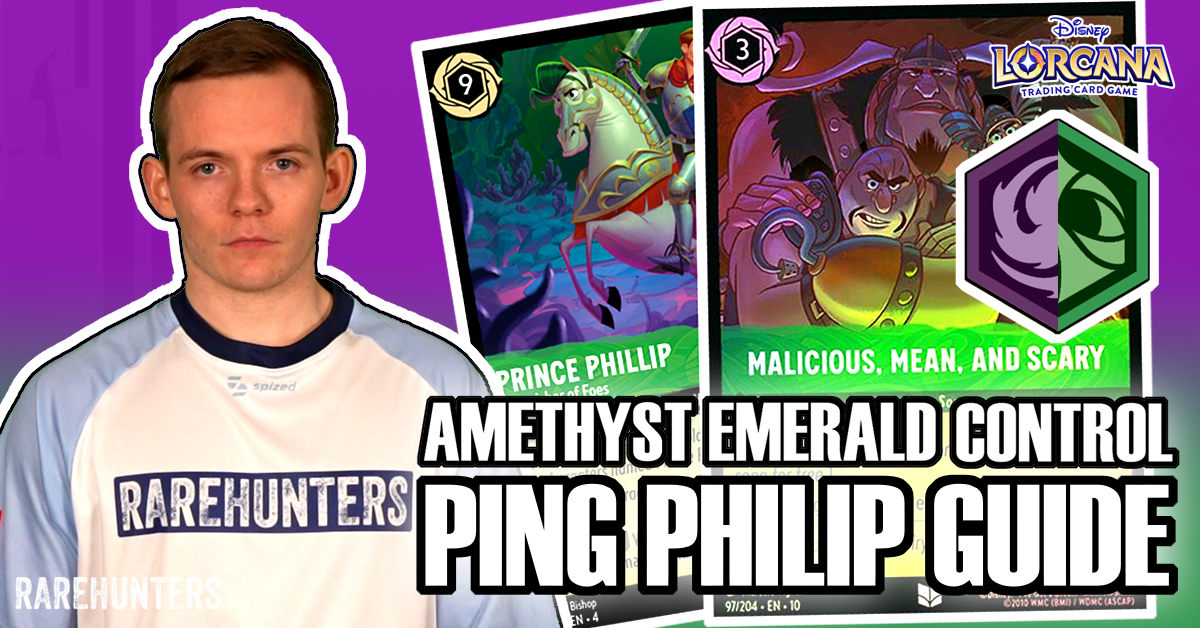
      • Prince Phillip – Vanquisher of Foes with Malicious, Mean, and Scary)
      • Under the Sea

    Best Parings for the Emerald Ink Identity

    Pairings that fix Emerald’s weaknesses or amplify its strengths shine the most.

    Historically, Emerald paired well with Steel for mid-game stability and removal. Recently, Amethyst/Emerald has risen as a hyper‑efficient early‑game tempo deck.

    But the two most competitively successful pairings right now are:

    Amber

    Amber plays into both of Emeralds current play-styles:

    • Aggro
      • Enhances Emerald’s early pressure
      • Uses premium dual‑ink aggro cards:
        Lady – Decisive Dog, Lady – Miss Park Avenue, Tramp – Street‑Smart Dog
      • Gains additional early questers like Daisy – Donald’s Date and Lilo – Escape Artist
    • Control / Singing
      • Enables early songs with Mickey Mouse – Amber Champion
      • Provides strong revival targets like:
        Stitch – Carefree Surfer

    Sapphire

    This pairing turbo‑charges the control plan:

    • Ramp Package
      • Turn 2 ramp: Tipo – Growing Son, Sail the Azurite Sea
      • Turn 4/5 ramp: Cinderella – Dream Come True, Kida – Creative Thinker
    • Premium Removal
      • Gains access to the best 2‑for‑1 in the game:
        Hades – Infernal Schemer

    Emerald Ink Identity Guide – Final Verdict

    Emerald is the counterpick to the Amethyst‑dominated meta.
    It doesn’t have 4–5 viable ink pairings like Amethyst — but it doesn’t need them.

    Amethyst stretches midrange to its limits.
    Emerald instead embraces the extremes:

    • Hyper‑Aggro
    • Hard Control

    If you enjoy playing the Rogue — slipping through defenses, stealing tempo, punishing greed, and striking when the opponent least expects it — then Emerald is the perfect color for you.

    I hope you enjoyed this Emerald Ink Identity Guide. If you think I missed something or want to dive deeper, feel free to reach out on my socials.

    Amber Ink Identity Author Photo
  • Amethyst Ink Identity Guide

    Amethyst Ink Identity Guide

    Amethyst Ink Identity Guide Photo

    Amethyst is the meta‑defining color right now — the villainous sorcerer sitting at the top of the Lorcana food chain. In this Amethyst Ink Identity Guide, I’ll walk you through exactly why it dominates.

    If Amber is the Paladin of the RPG party, Amethyst is the sorcerer: clever, slippery, and always armed with one more trick than you expected. Whether it’s locking down the board (Exert), or simply cantripping its way into more options (drawing cards), Amethyst never runs out of ways to stay ahead.

    As with the Amber Guide, this article focuses almost entirely on Amethyst itself — not dual‑ink combinations or specific decklists. You’ll find those in our deck‑specific guides.

    Amethyst Ink Identity – the evil sorcerer with many tricks up its sleeve

    Being a sorcerer isn’t enough for Amethyst — it insists on being a villainous sorcerer. It’s the only color in Lorcana with more Villains than Heroes, and that mischievous streak shows up everywhere: in its stats, its keywords, and its play patterns.

    • Evasive: “You’ll never catch me.”
    • Rush: “Strike first, ask questions never.”
    • Balanced Stats: “I’ll adapt to whatever you throw at me.”

    Strong keywords, flexible abilities, and unmatched adaptability define Amethyst — and the tournament results back it up.

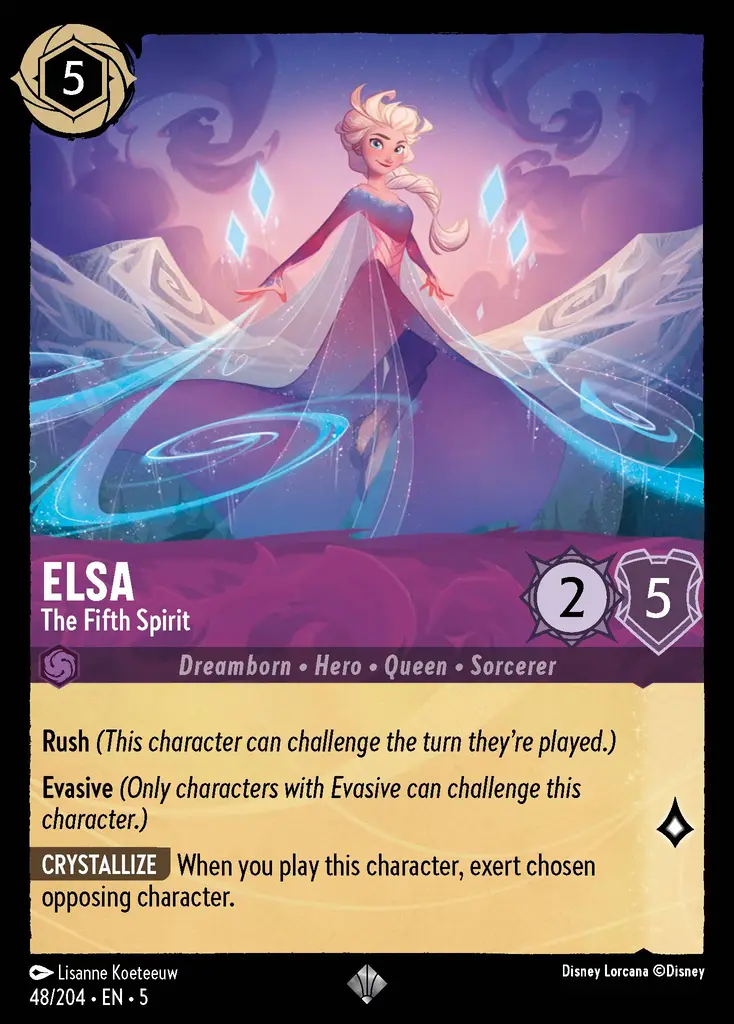
    If i had to choose one card to represent Amethyst the best id choose Elsa – The Fifth Spirit, even if shes a hero. Loads of keywords and sets up loads of combos.

    Amber Ink Identity most representing card: Else The Fifth Spirit

    General Themes — What Amethyst Wants to Do

    Amethyst has a crystal‑clear identity: trickery, villainy, and resourcefulness. Its characters don’t just play the game — they bend it.

    Here’s what Amethyst excels at:

    • Evasion
    • Drawing cards
    • Reusing cards (self‑bounce, replay value)
    • Board manipulation (forcing openings)
    • Punishing openings (moving damage, rushing in)

    Amethyst ink Identity Guide: Where it Stands in the Meta

    As mentioned earlier: Amethyst is the meta. You either play it, or you build your deck specifically to beat it — usually by going under it or by being even more disruptive.

    Strengths

    The best color in the game comes with a long list of strengths, but these three define it:

    • The Best Evasive Characters in Lorcana
      • Every Amethyst deck runs at least 12 Evasive characters — some run 20.
      • Just look at Ursula – Whisper of Vanessa and ask yourself: How exactly do you plan to deal with that?
    • Card Draw — With Upside
      • Other colors have conditional or awkward card draw like Clarabelle – Light on Her Hooves or pseudo‑draw like Cinderella – Dream Come True.Amethyst?
      • Amthyst just says “draw X cards” — often stapled onto a body or another benefit.
      • The gold standard remains Genie – Wish Fulfilled
    • Breaking Stale Board States
      • Opponents refusing to exert their key characters Amethyst will happily do it for them — and usually gains cards or board presence in the process.

    Weaknesses

    Even villains have flaws.

    • A Weaker Early Game
      • Not weak, but definitely weaker. Your early turns are often spent:
        • establishing control with Rafiki – Mystical Fighter or Royal Guard – Octopus Soldier
        • deploying resilient or self‑replacing characters like Diablo – Obedient Raven or Palace Guard – Spectral Sentry
      • That beeing said Amethyst recently got som strong early Lore tool’s as well with Meeko – Skittish Scrounger and Pocahontas – Following the Wind
    • Lack of Direct Removal
      • Amethyst doesn’t get “banish chosen character” or “deal 4 damage” effects.
      • You rely on combat and tricks instead — which fits the villain‑sorcerer theme perfectly.

    Essential Cards by Archetype – Who are the best of the best?

    The Amethyst Ink Identity offers flexible cards, so the best often shine across multiple archetypes, but here’s where they stand out most clearly:

    Card Draw

    • Junior Woodchuck Guidebook
    • Dumbo – Ninth Wonder of the Universe
    • Yzma – Conniving Chemist
    • Second Star to the Right

    Evasive

    • Genie – Wish Fulfilled
    • Ursula – Whisper of Vanessa
    • Sven – Leaping Reindeer

    Exerting

    • Elsa – The Fifth Spirit
    • Demona – Scourge of the Wyvern Clan

    Punishing

    • Cheshire Cat – Inexplicable
    • Belle – Accomplished Mystic
    • Tigger – Bouncing All the Way

    Best Pairings – What combines well with the Amethyst Ink Identity

    Or more fitting: What doesn’t? Amethyst is the only color that pairs well with every other ink.

    If you want to play a Control style Amethyst Deck your options are Amber and Sapphire. For an approach leaning more or even heavily into the aggro aspect of the Amethyst Ink Identity your best choices are Emerald and Steel

    Amber

    • Offers pseudo‑ramp via Lantern or disruption via Mowgli – Man Cub
    • Grants conditional removal like The Horseman Strikes! and World’s Greatest Criminal Mind, which often feel like premium answers in the current meta
    • Gives you the only “hard” board wipe in the game with Raging Storm

    Sapphire

    • Accelerates past your weaker early turns with Sail the Azurite Sea and Tipo – Growing Son
    • Provides elite 2‑for‑1 removal with Hades – Infernal Schemer
    • Adds in another hard Removal with Let it Go
    • Offers deck filtering via Develop Your Brain and Visions of the Future

    Steel

    • Gives you strong early‑game questers like Lilo – Bundled Up and Nala – Undaunted Lioness
    • Grants efficient spot removal through Strength of a Raging Fire and He Hurled His Thunderbolt
    • Adds even more card draw with Doc – Bold Knight

    Emerald

    • Gives strong lore pressure with cards like Cursed Merfolk – Ursula’s Handiwork, Scrooge Mcduck – S.H.U.S.H. Agent and Enigmatic Inkcaster
    • Gives premium disruption with Emerald Chromicon and Snow Fort

    Amethyst Ink Identity Guide – Final Verdict

    Amethyst is the villain of the Core Constructed meta and it revels in that role. You either try to beat it, or you embrace it.

    It does everything that matters, and its few weaknesses are easily patched by nearly every other color. That means you get to choose your favorite partner ink without sacrificing power.

    I hope you enjoyed this Amethyst Ink Identity Guide. If you think I missed something or want to dive deeper, feel free to reach out on my socials.

    Amethyst Ink Identity Author Photo
  • Amber Ink Identity Guide

    Amber Ink Identity Guide

    Amber Ink Identity Guide Photo

    From a competitive players standpoint: Let’s break down where Amber stands today, where it struggles, and where it shines in this Amber Ink Identity Guide.

    If Lorcana’s six inks were a classic RPG party, Amber would be the paladin: noble, supportive, full of good intentions… and occasionally face‑planting because it brought a healing spell to a sword fight. Amber continues to embody the “good” or at least “lawful” side of the color pie.

    A quick disclaimer: I will mostly talk about amber in isolation, but there will be sections about dual-ink cards and pairings later. This Guide is currently focused on Core-Cnstructed.

    Amber Ink Identity – lawful good, heroic, and sometimes too nice for Its own good

    Amber is the ink of heroes (even more than other colors) More than half of all Amber characters currently legal in Core are Hero‑sub-type, and the mechanics reflect that moral compass:

    • Bodyguard: “I’ll take the hit for you.”
    • Support: “I’ll help you hit harder.”
    • Singer: “I’ll motivate you.”
    • High Willpower: “I’m not dying today,”

    It’s wholesome, thematic and also occasionally like trying to win a tournament with a basket of puppies (which sometimes works but I’d recommend playing dogs).

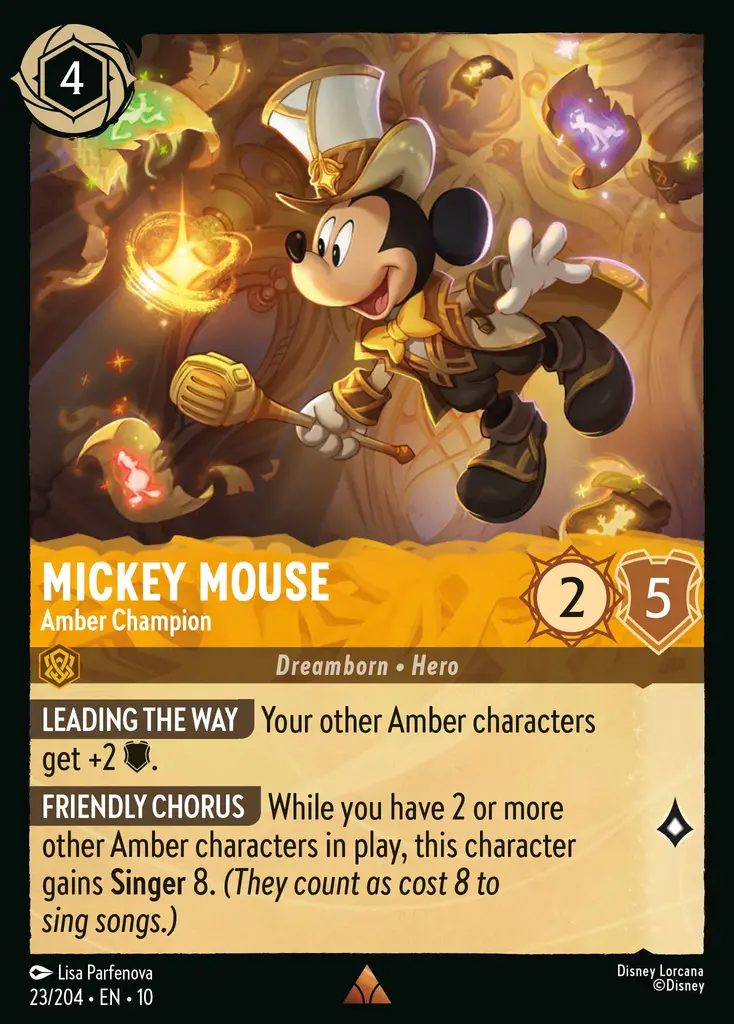
    The card that represents all this the best is in my opinion Mickey Mouse – Amber Champion. He supports hes little friends and in return gets supported by them (to sing some tunes with his presumably angelic voice).

    Amber Ink Identity most representing card: Mickey Mouse Amber Champion

    General Themes – What Amber wants to do

    Amber wants to bring a basket full of puppies and keep it safe and happy. It does this by:

    • Singing
    • Healing
    • Going wide (and rewarding you for it)
    • Protection (big bodies shielding your board)
    • Recursion (bringing characters back from the discard)

    Amber is the color of community, teamwork, and “we’re all in this together.”

    Recently Amber also got a “pacifist” theme added to it with Pocahontas cards like Pocahontas – Peacekeeper or John Smith – Snow Tracker which reward you for not changing which might play well into a color locked into aggro anyways.

    Putting the Guide in Amber Ink Identity – Where Amber Stands in the Meta

    Let’s be blunt: Amber was historically one of the weaker colors but recently got a lot of new tools. Those are mostly leaning into its existing strengths but open up some new venues of play as well. In general is Amber probably the color which gained the most from Winterspell but if that’s enough to push it past the Amethyst dominance remains to be seen.

    Strengths

    Amber has one real, tangible strength — and when you lean into it, the color can absolutely perform.

    • Fast Lore Generation

    Amber Ink Identity is closely linked to early and consistent lore pressure. Cheap characters with mane lore pips, which sometimes even are sturdy.

    Weaknesses

    The weakest parts of amber have been improved but still here they are:

    • Card Draw? Only conditional
      • Amber’s draw options are mostly:
        • As a payoff for Healing like Julieta Madrigal – Excellent Cook and Ohana Means Family
        • As a payoff for having a wide board like Stitch – Carefree Surfer and Stitch – Carefree Snowboarder
        • As a payoff for playing “Weenies” like Nani – Stage Manager and Stitch – Rock Star
      • This used to be one of the weakest parts of Amber but got a lot of new options with Winterspell.
    • Interaction? Also conditional
      • In general Amber can only remove using conditional cards
        • examples are World’s Greates Criminal Mind) and [The Horsman Strikes!
    • Healing Is Overcosted and Underwhelming
      • Healing is one of Amber’s core themes — and yet it’s almost never relevant, expet when enough Cards are attache to it.
        The effects are:
        • too small
        • too slow
        • too expensive
    • Singers Are Mostly a Trap
      • Amber has a singing theme, but the songs don’t justify the setup:
        • Cheap songs like Strength of a Raging Fire give little value when sung early.
        • Late‑game songs require so much setup that you might as well just play ramp and skip the choir practice.
      • The singers in Ruby have better stats and effects.

    Essential Cards by Archetype – Who and What in Amber does it best

    After all this yapping this wouldn’t be a real Amber Ink Identity Guide if we didn’t look at some color defining cards.

    Aggro Core

    These are your bread‑and‑butter if you want to push early lore and or keep it safe:

    • Daisy Duck – Donald’s Date
    • Lady – Family Dog
    • Tiana – Restaurant Owner
    • Grandmother Willow

    Fast, efficient, and exactly what Amber needs to get ahead before the opponent starts playing real cards.

    Singing Package

    If you insist on singing (I won’t judge, I am a steel-song enthusiast after all):

    • Angel – Siren Singer
    • Mickey Mouse – Amber Champion
    • Ursula – Vanessa

    These are the only singers that feel worth the deck slots.

    Recursion Tools

    Amber’s recursion is surprisingly solid when it comes to characters. It could be summarized in the other two archetypes but i wanted to point it out:

    • Lilo – Escape Artist
    • Circle of Life

    If you want to loop value, this is your best angle. Lilo of course goes into the aggro style deck while Circle of Life belongs to the singers.

    Healing Package

    Before Winterspell the answer was none. Now one card makes this Category by the sheer potential if its drawing power:

    • Ohana Means Family

    Best PairingsWhat combines well with the Amber Ink Identity

    Amber shines brightest when paired with a color that covers its weaknesses (and supports the aggro playstyle). WIth some new additions (especially Raging Storm) there might be a Control Deck hidden somewhere but i think aggro is where Amber is still at.

    • Steel: fixes interaction, gives removal, card draw and more aggro
    • Emerald: adds disruption, card filtering and more aggro

    The issue of dual ink cards and the Amber Ink Identity

    No other color has their high impact cards so far spread out between all their dual ink pairings like amber. While for example Amethyst decks use 0-2 play-sets of dual ink cards (like Into the Unknownor Giant Cobra – Ghostly Serpent). Many problems of amber would be fixed if some of those dual cards would just be amber cards.

    The Amber/Steel dual cards for example all feel like amber cards with resist tagged on and should have probably just been regular amber cards. You you will likely find Rhino – Power Hamster, Penny – Bolt’s Person andThe Troubadour – Musical Narrator in most Amber/Steel decks.

    In Amber/Emerald you play almost all dual cards. Some cards like Tramp – Street-Smart Dog feel like they should be dual color for their effect per character and discard, but cards like Lady – Decisive Dog and Lady – Miss Park Avenue should in my opinion just be Amber since its classic going wide payoff and/or character recursion.

    Amber Ink Identity Guide – Final Verdict

    Amber got quite a Buff which patched many of its major weaknesses. It’s the best standalone color for Aggro strategies and if those are able to compete the color will shine. Winterspell helped Aggro out a lot but also brought a lot of Control tools so it’s still quite open how well Amber can perform.

    Amber in Core Constructed is a color with a strong identity, great flavor, and now more than a few standout cards — but it might be held back by to strong of a Control/Mid range Meta.

    Still, with the right partner and the right build, Amber can shine — I’d just stuck to Aggro for now.

    I hope you liked reading this Amber Ink Identity Guide. Feel free to hit me up on my socials if I missed anything or you want to further discuss.

    Amber Ink Identity Author Photo
  • EMERALD AMETHYST META DECK GUIDE

    EMERALD AMETHYST META DECK GUIDE

    Estimated reading time: 8 minutes

    Hello everyone and welcome to my EMERALD AMETHYST META DECK GUIDE. Today we are going to explore what this deck is all about, and it’s place in the Meta. This guide will be an introduction on how to play this deck correct and show it’s potential.

    EMERALD AMETHYST META DECK GUIDE Image

    Emerald Amethyst is the most flexible deck in this meta game and excels during the early and middle of games. The deck makes use of Emerald cards to generate early advantage. It then make use of the consistent Amethyst cards to snowball and close the game out. The deck is tricky to play with a few different shift lines but mastering the EMERALD AMETHYST META DECK GUIDE.

    Emerald Amethyst META deck guide

    Ink identity

    In order to fully understand the deck must explore the identity of each ink. Here is the list we will be using to show this:

    Emerald

    Emerald as an ink colour is known for it’s versatility. Firstly emerald gives you access a powerful card draw engine with Clarabelle – Light on Her Hooves. This engine can be abused by singing powerful songs for no costs such as Mother Knows Best and You’re Welcome. In addition to this it has a difficult to interact with ramp engine using the newly released Webby Vanderquack – Mystery Enthusiast and Webby Vanderquack – Junior Prospector. Then maybe the most powerful of all a one sided board wipe to take over the game.

    Amethyst

    As an ink colour Amethyst is known primarily for it card advantage engines. It has access to many draw cards including; Genie – Wish Fulfilled,Hades – Looking for a Deal and Demona – Scourge of the Wyvern Clan. Amethyst also gain card advantage by returning cards back to hand and this allows their powerful triggers to be used additional times. Cards that facilitate this include Olaf – Helping HandMadam Mim – Elephant and Magical Maneuvers. Amethyst not has cards that gain advantage but also tempo generating cards that set up favourable trades or act as forms of removal. Examples of this in the deck are Elsa – The Fifth SpiritCheshire Cat – Inexplicable and Magical Maneuvers. However the powerful legendary cards from Whispers in the Well Hades – Looking for a Deal and Demona – Scourge of the Wyvern Clan are also super powerful tempo tools.

    Emerald Amethyst META deck guide breakdown

    1 Cost Cards

    • Webby Vanderquack – Mystery Enthusiast – Intergral part of the ramp shift line but also a powerful stand alone card to create favourable trades
    • Clarabelle – Clumsy Guest – Part of the shift line that facilitate the main card draw engine, however the trigger effect is also fairly relevant as items are in the META
    • Olaf – Helping Hand – An incredibly underrated card that has extreme flexibility by recycling many key resources and insulates the deck against prince phillip combo

    2 Cost Cards

    • Diablo – Spiteful Raven – An incredible evasive threat that can not only lock down early questing, but also applies pressure to the game if not answered early.
    • Go Go Tomago – Darting Dynamo – A tricky and technical tool to use to gain massive lore advantage and close out games, however mastering this evasive card will level up your game.
    • Ursula – Deceiver – One of the most powerful low cost cards in the game removing META staple songs, but most importantly it provides complete hand knowledge so you can prepare a solid game plan to close out games.

    3 Cost Cards

    • Clarabelle – Contented Wallflower – Part of the shift line that facilitates the main engine of the deck. The trigger effect more often than not also draws a card which is super powerful.
    • Prince Phillip – Royal Explorer – Mainly included as the best shift target for the flood born Prince Phillip. However ward is very difficult to interact with and its also just a decently stated card.
    • Cheshire Cat – Inexplicable – It’s well stated for 3 ink, inkable in the match ups where it doesn’t shine. This whisper card allows damage to be transferred from the board to opposing characters creating insane value and tempo and on curve it create so much pressure to the board.
    • Malicious, Mean, and Scary – Part of the one sided board wipe combo to damage all characters on the other side. As a standalone card it’s also fine to play to create valuable trades and at worst it’s also inkable if you can’t see any line to play it or draw too many of them.
    • Mother Knows Best – A very flexible song that can be played for free most of the time. It can bounce an opponents cards to generate a massive tempo swing in the early game and draw cards with flood born Clarabelle. But it can also be used to reuse you own characters.

    4 Cost Cards

    • Genie – Wish Fulfilled – A staple in amethyst deck since release. It draws a card on play, has great stats and most importantly is evasive. Often unchecked a couple of genie will just take over the game with ease.
    • Webby Vanderquack – Junior Prospector – One of the main flood born cards in the deck. It allows you catch up on ink when you are behind in the game, and can often let you keep cards in hand rather than inking. It also has ward so its super hard to deal with early game and can come down turn 2 to take over the game.
    • Madam Mim – Elephant – A super well stated card for 4 ink, that also gets to transfer damage at the start of your turn. It returns a card to hand as cost to play. How this generates advantage by reusing a resource you’ve already played.
    • You’re Welcome – A staple song in emerald decks, that act as ideal removal or in the worst case act a pseudo draw card to get you back in the game. Most importantly it’s synergy with Clarabelle to generate tempo and also symmetrically draw 2 is very important to stay ahead.

    5+ Cost Cards

    • Elsa – The Fifth Spirit – Another staple evasive card in amethyst that exerts a character to create favourable challenges. It’s very good on curve and also as a late game control piece to keep the game locked down.
    • Hades – Looking for a Deal – A very strong card that has two strong effects, drawing cards and removing a character from the board. The only downside being your opponents gets to choose their fate. The power of this card is insane, but it can sometimes feel useless when you are behind or if you’ve established a Clarabelle and drawing the cards was going to happen anyways.
    • Demona – Scourge of the Wyvern Clan – Everything you would want in a mid/late game amethyst card. Strong stats, exert the opponent’s board and most importantly for purple it draws cards. It’s a super impactful control tool that is also inkable if it’s unfavourable to give your opponent 3 cards.
    • Clarabelle – Light on Her Hooves – A very strong flood born character that is the main draw engine of the deck. It super well stated and can be difficult to remove, and it’s synergises so well with the emerald disruption package that the deck plays.
    • Prince Phillip – Vanquisher of Foes – A larger stated flood born menace that banishes all opposing damaged characters. Is often combo with Malicious Mean and Scary to wipe the board, despite this it is also a solid card on it’s as a 6 stated evasive and is a must answer card with it’s 3 lore.

    EMERALD AMETHYST META DECK TECH CHOICES

    Firstly the Emerald Amethyst deck has access to so many powerful cards that options are endless. Here is a list of some cards that would be excellent includes, however change them up as the meta shifts:

    • Diablo – Obedient Raven
    • Flynn Rider – Spectral Scoundrel
    • Improvise
    • Pegasus – Gift for Hercules
    • Rafiki – Mystical Fighter
    • Royal Guard – Octopus Soldier
    • Hypnotic Strength
    • Iago – Stompin’ Mad
    • Junior Woodchuck Guidebook
    • Akela – Forest Runner
    • Elsa – Exploring the Unknown
    • Emerald Chromicon
    • Louis – Endearing Alligator
    • Tinker Bell – Fast Flier
    • They Never Come Back
    • Demona – Betrayer of the Clan
    • Donald Duck – Perfect Gentleman
    • Dumbo – Ninth Wonder of the Universe
    • Iago – Giant Spectral Parrot
    • Belle – Accomplished Mystic
    • Ursula – Voice Stealer
    • Monstro – Infamous Whale
    • Stopped Chaos in Its Tracks
    • Under the Sea

    EMERALD AMETHYSTS META DECK FORMAT POSITION

    In my experience of card games I have found that there are often 3 pillars of a meta which are aggro, control and midrange decks. More often than not aggro beats control, control beats midrange and midrange beats aggro, and a healthy meta game has a strong balance of all 3 playstyles. This Emerald Amethyst meta deck is in a unique position as it has the capacity to thrive within all pillars of the meta game, giving it the potential to have META breaking potential.

    In the Whispers in the Well format there are currently 3 main decks at the forefront of the meta game. Those are Amethyst Steel (Midrange), Amethyst Sapphire (Midrange/Control) and Sapphire Emerald (Midrange/Control). However there are also 3 aggro decks in the format. Being Amber Emerald, Amber Steel and Emerald Amethysts (burn). Aggressive decks are also strong forces in the meta and must be taken into account.

    Taking all of this on board the EMERALD AMETHYSTS META DECK is in a prime position to succeed. Mainly because it has all the tools to combat a very wide and diverse META. The main issue with the EMERALD AMETHYSTS META DECK is that other amethyst deck just fill it’s role better. Despite this I would say the Emerald Amethyst deck is strong B/C tier deck and should not be underestimated.

    CLOSING THOUGHTS

    The EMERALD AMETHYSTS META DECK may not be the most powerful deck in this metagame. However, it is so much fun to play and very rewarding to master.

    If you enjoyed reading through this guide please check out other awesome content from all the team. Content can be found our new website and stay up to date with all of our success.

    Please check out my socials for more content and any updates. Most importantly thanks for reading and all the support.

  • Ruby Amethyst Starter Guide

    Ruby Amethyst Starter Guide

    Ruby Amethyst Starter Guide photo

    After rotation and with the release of Set 10, Whispers in the Well, Ruby Amethyst has undergone a drastic transformation. Gone is the slow and methodical card advantage behemoth, that sought to grind your opponent down. Ruby Amethyst has turned into a board centric, lean and mean questing machine. Its playstyle is closer to the aggressive Amethyst Steel or Emerald Amethyst decks of old.

    Example Decklist and Gameplan

    Going into this Ruby Amethyst Starter Guide let’s first take a look at the decklist that got second place at the recent Enchanted Tour 2025 – Christmas Edition, piloted by Riccardo Picciafuochi.

    The deck is almost all characters with solid stats for the cost and tons of questing power. The gameplan is simple, yet effective:

    • play your best character every turn
    • quest as much as you safely can
    • take favorable challenges, while questing with your other characters
    • use your powerful 5-cost characters to keep your board safe
    • refill your hand with Dumbo – Ninth Wonder of the Universe and Demona – Scourge of the Wyvern Clan

    The cost of this straight forward gameplan is that it is pretty hard to catch back up if you have fallen behind too much. This means you have to make sure to get as much lore out of the early game as possible, so you can squeeze out the last few points, once your opponent starts to overtake you.

    Altering with Ruby Amethyst

    Since your main gameplan in Ruby Amethyst is to play the best character every turn, you need to alter your starting hand aggressively to hit your early game.

    • If you are missing a 1, 2 or 3-cost: alter every card that costs 4+
    • Except: I personally like to keep Genie – Wish Fulfilled if I am the starting player, to make getting to Demona – Scourge of the Wyvern Clan easier
    • If you have the 1-2-3 curve already you can keep a 4 and or 5 cost, if you have inkables to spare.

    Tips and Tricks for Ruby Amethyst

    • Against Steel Decks, Hercules – Mighty Leader is a great play on turn 4, since they cannot get rid of him with Strength of a Raging Fire.
    • Lumiere – Fiery Friend makes the trading game very hard for your opponents, keep him safe, he’s your precious.
    • The Headless Horseman – Terror of Sleepy Hollow triggers on every banish, so your characters get bigger and bigger, use him to clear as much as possible.

    Possible Card Changes

    Next Stop, Olympus

    …is a great tempo play if you get to play it for free. You can challenge an additional character while gaining lore. It is also an answer to Iago – Giant Spectral Parrot, which can be a huge problem.

    They Never Come Back

    …keeps your opponent’s characters locked down for a turn and allows you to gain some free points. It is also an answer to Iago – Giant Spectral Parrot.

    Hypnotic Strength

    …Hey, it’s another answer to Iago! Notice a trend?

    Medallion Weights

    …helps you win the evasive wars against other Amethyst decks, while drawing you cards. It’s also really great in combination with Next Stop, Olympus. So if you put the Medallion Weights in your deck, also add some Next Stop, Olympus.

    Hades – Looking for a Deal

    …is just a great card. The only problem with him is, that he competes with Elsa – The Fifth Spiritand The Headless Horseman – Terror of Sleepy Hollow for his slot. A mix of all three would be fine though, if that’s more to your liking.

    Conclusion

    Ruby Amethyst is solid choice in the current Metagame. It has good matchups into some of the slower decks, due to its speed and like to beat up the cute doggies. It lacks a bit in flexibility and can struggle once it is behind – but if you are a fan of curving out, questing a lot and trying to ignore your opponent as much as possible, Ruby Amethyst might just be the deck for you!

    And that is it for this quick, little Ruby Amethyst Starter Guide

    Socials

    If you want to read more of my content and follow my Lorcana Journey you can follow me on:

    https://twitter.com/LukasKaupaTCG

    https://www.instagram.com/lk_tcg

    https://metafy.gg/@lk-tcg

    rarehunters.team

    Ruby Amethyst Starter Guide photo
  • Monstro OTK Combo – META Deck Introductory Guide

    Monstro OTK Combo – META Deck Introductory Guide

    Monstro OTK Combo – META Deck Introductory Guide images

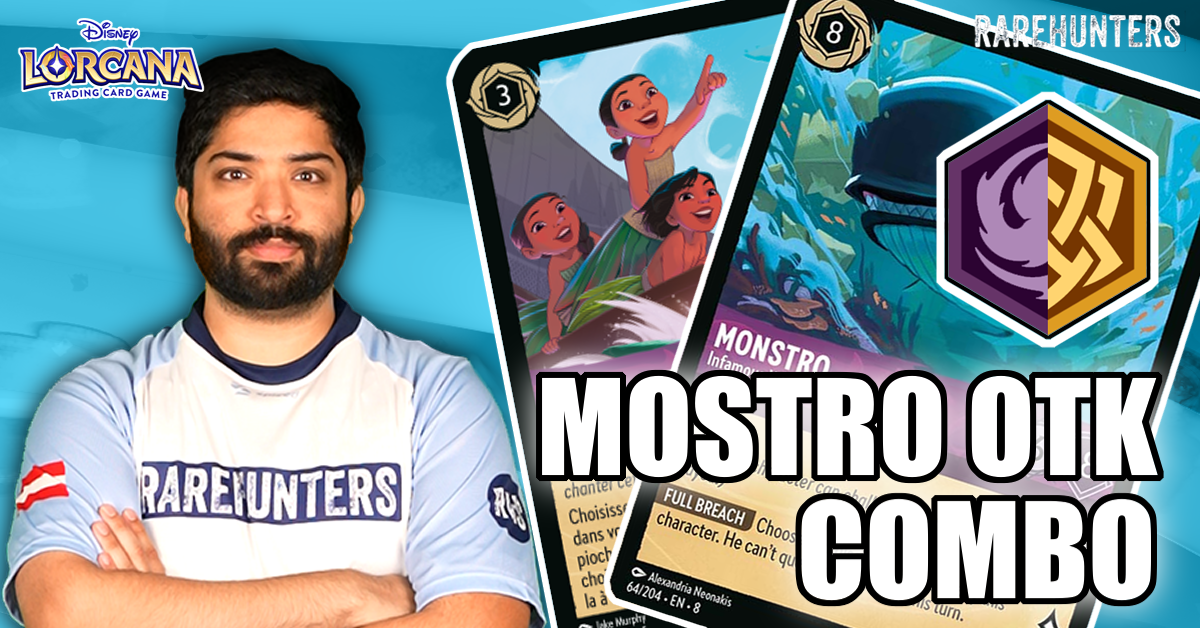
    The Monstro OTK Combo deck is one of the most explosive and technically demanding strategies currently available in Core Constructed. Rather than winning through incremental lore gains, this deck is built to engineer a single game-ending turn that overwhelms the opponent before they can meaningfully respond.

    In this Monstro OTK Combo – META Deck Introductory Guide, by combining Amethyst’s card draw and ramp with Amber’s acceleration and tempo tools, Monstro OTK Combo rewards patience, discipline, and precise sequencing. When piloted correctly, it can compete with and often punish every major archetype in the current meta.

    Decklist – Monstro OTK Combo

    Deck Philosophy

    Monstro OTK Combo is a setup-first combo deck. It does not aim to race early lore totals or dominate the board from the opening turns. Instead, it focuses on resource advantage, controlled pacing, and inevitability.

    The deck accelerates and smooths its early turns, draws aggressively without overcommitting, disrupts opposing tempo just enough to survive, and converts several turns of preparation into one decisive Monstro turn. A great curve is lantern into Genie then Hades. The pressure this creates forces opponents into inefficient lines well before the combo actually happens.

    How the Combo Works

    The combo centers around Monstro and The Great Illuminary, which together allow you to draw through and discard your entire deck in a single turn. Once your deck is fully cycled, you use We Know The Way to bring back Alan-a-Dale – Rockin’ Rooster from the discard pile. With a second copy of We Know The Way, you can initiate a repeatable loop that continually reuses Alan-a-Dale – Rockin’ Rooster. This loop generates unlimited lore, allowing you to win the game once the sequence begins immediately. Because the combo is deterministic once started, the deck’s primary challenge is not execution but correctly timing when it is safe to start the combo.

    Ink Identity – Monstro OTK Combo

    For this Monstro OTK Combo – META Deck Introductory Guide, we will be discussing the Identities of the Ink involved in the the deck.

    Amethyst forms the engine of the deck. Cards such as Genie – Wish Fulfilled, Hades – Looking for a Deal, Junior Woodchuck Guidebook, and Cheshire Cat – Inexplicable allow the deck to churn through cards efficiently while maintaining flexibility. Amethyst ensures that the deck finds Monstro consistently, recovers from disruption, and remains functional even in longer games. This is what turns the deck from a fragile combo into a reliable competitive strategy.

    Amber provides acceleration, tempo control, and traditional hard removal in The Horseman Strikes!. Lantern allows the deck to reach key turns earlier, while characters like Rafiki, Royal Guard, Huey, and Iago influence combat and positioning without requiring full commitment. Amber enables the deck to stabilize through efficiency and timing rather than brute force.

    How the Deck Plays – Monstro OTK Combo

    In the early game, the focus is on inking cleanly and establishing draw engines. Lantern helps smooth awkward curves, while Guidebook, Genie, and Hades keep resources flowing. Interaction is used conservatively, prioritizing survival and avoiding unnecessary trades.

    The midgame is where Monstro’s OTK Combo quietly takes control. Amber’s tools prevent opponents from executing clean game plans, while Amethyst continues digging toward Monstro and its supporting pieces. Many opponents feel ahead during this phase, which is precisely where the deck wants them.

    Once conditions are met, Monstro – Infamous Whale becomes the centerpiece of a devastating swing turn. Through careful sequencing, acceleration, and preparation, the deck converts incremental setup into an overwhelming burst that ends the game immediately or leaves the opponent without viable responses. Knowing when not to go for the combo is just as important as executing it correctly.

    How the Deck Plays – Monstro OTK Combo

    Monstro – Infamous Whale serves as the primary win condition and inevitability engine. Lantern and We Know The Way control timing and acceleration. Genie, Hades, and Junior Woodchuck Guidebook provide consistency and card advantage. Rafiki, Royal Guard, and Iago manage tempo and survivability. Elsa and Demona influence the board while applying pressure without forcing overextension. Cheshire Cat offers flexible value that opponents find hard to answer cleanly.

    Every slot either advances the combo or buys it time.

    Role in the Meta

    Monstro OTK Combo occupies a unique niche in the current environment. Against aggressive decks, the focus is survival and efficiency rather than racing. Against midrange strategies, the deck punishes overextension and inefficient trades. Lastly, against control, it leverages inevitability and forces opponents to act first.

    The constant threat of a one-turn kill warps decision-making and often creates advantages before Monstro ever enters play.

    Mulligan Strategy – Monstro OTK Combo

    The mulligan with Monstro OTK Combo is centered around Lantern, which is the most crucial card to see early and should almost always be kept. The rest of the opening hand should focus on buying time rather than applying pressure, with one-cost characters like Rafiki – Mystical Fighter and Royal Guard – Octopus Soldier creating early board stalls that protect your life total. A strong hand pairs Lantern with at least one early stabilizing character and a way to continue setting up, allowing you to ramp, survive, and assemble your combo without rushing the win condition.

    Conclusion – Monstro OTK Combo

    Monstro OTK Combo is a high-skill, high-reward deck that thrives on planning, patience, and precise execution. It may not be the most straightforward strategy to master, but few decks in Lorcana offer a more satisfying or decisive win condition.

    For players who enjoy combo strategies, resource mastery, and winning games on their own terms, Monstro OTK Combo is one of the most potent and rewarding choices in the current meta.

    Monstro combo deck

    If you want to learn more, you can find the complete guide here: https://metafy.gg/@zansyed